How Can Recall Alerts Reach Stakeholders Before Rumors Take Hold?
How can a mid-sized manufacturer notify regulators, retail partners, and consumers across multiple markets before social media speculation dictates the narrative? The operational answer starts with a verified product boundary, a clear reporting route, and instructions each recipient can execute.
In the supplied incident record, quality logged a batch-level component failure at 07:40 on a Tuesday in March 2024. Counsel received the first escalation, ahead of the agency. By 09:10, a four-function incident cell had assembled. The immediate decision was an outbound hold while logistics checked departing trailers and quality isolated the affected SKU lots.
Before noon, the manufacturer froze outbound movements across three distribution nodes, covering an 11-day production window. External wording remained on hold until hour 11, when the SKU manifest was locked and the regulator filing path confirmed. That sequence gave communications a defensible distribution boundary before anyone described the affected goods publicly.
This case reconstruction describes the supplied incident log; it does not establish a universal reporting timetable. Frameworks developed for New York or national consumer brands provide a planning baseline, while physical-goods recalls require product-category and jurisdiction-specific legal alignment. A communications clock must never override a mandatory reporting or urgent safety obligation.
For the U.S. reporting route, teams should check the U.S. Consumer Product Safety Commission recall guidance. Other markets need their own regulatory owners and approved local instructions.
Put Regulatory Filing and Retail Instructions Ahead of the Wire
The cascade ran through regulatory filing, account-manager preparation, named-buyer briefings, and public release. Each handoff carried a different operational requirement: regulators needed the reportable facts; retailers needed a stock-handling script; consumers needed a clear return route.
Resolve the Serial-Range Decision
Between hours 12 and 14, the desk drafted a broad precautionary statement naming the product family without serial ranges. Two routes were available: publish that broader warning immediately, or spend another six hours verifying the affected range.
An immediate statement could support urgent protective action, but an incomplete boundary could also leave retailers unable to distinguish affected stock. Waiting could produce more precise instructions while leaving an information gap. The decision therefore required a safety and legal assessment, rather than a preference for a cleaner announcement.
In this case, the team discarded the precautionary draft. Quality closed the serial ranges at hour 20; the public wire at hour 32 finally named them. The contrast matters: the later statement gave recipients an identification task they could complete.
Give Buyers a Usable Handling Script
The regulator portal filing formed part of the phase-one close at hour 18. At hour 26, account managers received a 14-item FAQ. Named buyers then received briefings at hour 28, four hours before the public wire.
That interval let account managers work from approved logistics instructions before consumers began asking questions. The FAQ supplied a common basis for discussing affected stock, escalation, and the customer response, reducing the opportunity for individual stores to improvise vendor statements.
Check Buyer Coverage
The four-hour briefing interval depended on an existing named retail-account list. Anonymous marketplace sellers had no equivalent buyer desk, and resellers outside the retailer-hold list remained beyond that direct notification chain.
Before release, the consumer instruction had been reduced to three return steps. The communication task was specific: identify the affected goods and explain the return process without introducing an unverified liability admission.
Keep Every Recall Response on One Approved Record
Between hours 36 and 60, one spokesperson desk handled trade and consumer inquiries continuously. Replies drew from a single living document on the activated crisis site. The document changed twice during that period, with each revision signed by both the spokesperson and counsel.
Single spokesperson, single document describes an approval system. Regional teams can distribute localized instructions, but each version needs to preserve the approved product boundary, verified testing facts, and remediation terms. Independent regional explanations would create competing records of the same recall.
Separate Test Findings From Delivery Commitments
Root-cause language stayed off the page until the testing note arrived. Replacement timing used a 10-to-14-day reverse-logistics window rather than an open-ended pledge. That wording connected the response to an operational interval without implying a guaranteed replacement date.
The main traps were predictable: guessing at the component failure, minimizing defect severity before testing supported that judgment, and offering vague replacement assurances. Each would introduce a claim that the approved record could not substantiate.
A practical response discipline follows from the case: identify the question, locate the verified answer, and route any unsupported point for review before updating the shared record. This keeps press responses traceable. It also makes the boundary visible: the manufacturer could control its approved statements, while unbriefed resellers could still publish their own interpretations.
Run the Recall Through Three Documented Handoffs
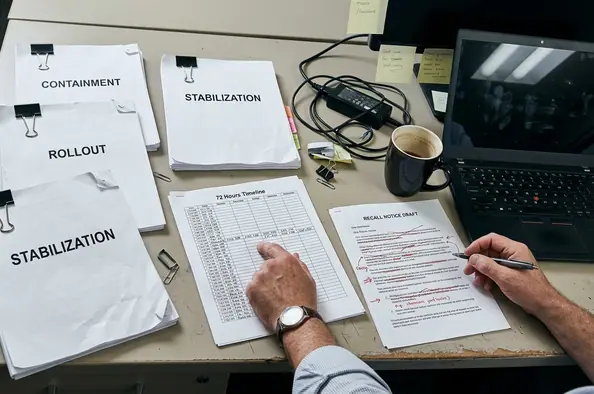
The 72-hour model follows changes in operational ownership. Containment ends with the reporting and drafting package; rollout ends with functioning consumer channels; stabilization ends with a supply-chain continuity message. Executive teams can copy the handoffs while assigning local reporting requirements separately.
Hours 0–18: Contain Stock and Lock the Reporting Package
- Open the incident record. Record the 07:40 quality escalation and assemble the four-person command cell across quality, legal, logistics, and communications. Keep factual verification and external wording in the same decision process.
- Establish the stock boundary. Freeze outbound movements across the three distribution nodes, identify departed trailers, and lock the SKU manifest covering the affected 11-day production window.
- Complete the first handoff. By hour 18, close the regulator portal filing and approve the Retailer Hold Notice, Press Release, and Customer Care Script. Keep serial-range verification as an explicit outstanding task until quality closes it at hour 20.
Hours 19–48: Brief Retailers and Open the Consumer Route
- Insert the verified ranges. Use the hour-20 confirmation to align the product identifiers across the release, retailer materials, and customer-care wording.
- Prepare the buyer conversation. Distribute the 14-item FAQ at hour 26. Conduct named-buyer briefings at hour 28 using the approved logistics script.
- Release the advisory. Issue the factual wire at hour 32 with the three-step return instruction. Close phase two by hour 48 with executive buyer briefings complete and the toll-free remediation line and dedicated web portal live.
Hours 49–72: Carry the Approved Facts Into Supply Recovery
- Maintain the response record. Continue the spokesperson-and-counsel approval process through the hour-60 media-management period. Preserve the stated 10-to-14-day reverse-logistics window across responses.
- Complete the partner handoff. At hour 72, the CEO memo to retail supply-chain partners carried three headings from the approved operational record: supply continuity, defective-stock reverse logistics, and confirmed corrective action. Each heading repeated only what that record had already confirmed, and the same instructions then appeared in the retailer response materials.