
From Novelty to Infrastructure: The Changing Financial News Desk
The historical frame for financial technology media reveals a stark transition in editorial priorities. Between 2015 and 2018, financial journalism treated consumer-finance applications as disruptive novelties, dedicating substantial column inches to origin stories and user interface innovations. By the 2022–2024 period, that editorial leniency had vanished. Desks now commission fintech coverage exclusively when the narrative sits inside broader policy discussions or market-structure reporting. Securing tier-one media attention requires a fundamental understanding of this editorial evolution.
This shift in journalistic focus directly impacts the timeline and mechanics of a market launch. Correspondent slots for new consumer-finance apps compressed from multi-week feature windows in 2016–2017 to 48- to 72-hour news-cycle slots by late 2023. Reporters no longer have the luxury of spending weeks evaluating a single application's market potential. They are filing against daily macroeconomic developments, regulatory shifts, and institutional market movements. A communications strategy that ignores this compression will fail to secure meaningful placement.
Consequently, the pre-launch narrative lock now occupies a 14- to 19-week runway. Every talking point, executive quote, and background document must be frozen long before the first off-record desk conversation occurs. This extended runway is necessary to align internal product realities with the external demands of a highly scrutinized sector. The Reuters Institute for the Study of Journalism frequently highlights how specialized reporting desks are demanding higher levels of technical and regulatory literacy from their sources. Pitching a functional application is insufficient; the brand must articulate its position within the broader financial ecosystem.
At Kwitco, the baseline assumption for any regulated launch is that product features are secondary to market structure. The media wants to know how a new platform handles settlement risks, navigates compliance frameworks, and impacts existing institutional relationships. Building a campaign around these complex themes requires a rigorous, front-loaded communications architecture.
Mapping Incumbent Media Relationships and Regulatory Boundaries
A common error in pre-launch planning is treating the media landscape as a blank slate. Emerging brands often assume that a superior product will naturally command attention, ignoring the entrenched relationships legacy competitors have already established with key financial desks. The root cause of this oversight is a failure to conduct proper relationship mapping. The fix requires mapping the competitor set as a media-relationship diagram first.
This diagram must identify which desks already hold standing background access to incumbent issuers. Understanding these existing channels allows a communications team to identify remaining gaps that can be entered without inviting a feature-comparison piece the brand cannot win. If a senior correspondent relies on a legacy competitor for background context on yield generation, pitching that same correspondent with a rival yield product will likely result in a dismissive comparison. The strategy must locate the reporters who are actively questioning the incumbents' infrastructure, rather than those who are comfortably relying on it.
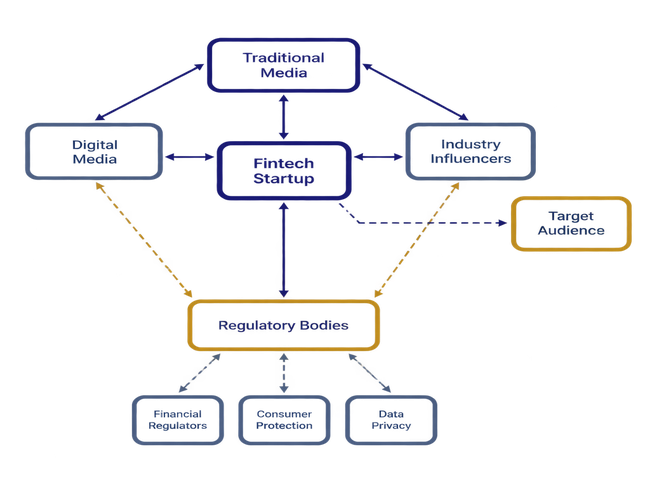
Operating within a regulated financial environment introduces severe constraints on how and when these narratives can be deployed. Legal review required a 5- to 8-business-day turnaround on every on-record quote touching deposits, yield, or custody. This latency means that reactive PR—responding to a reporter's inquiry with a fresh, legally approved quote on the same day, is structurally impossible. Every potential question regarding these sensitive topics must be anticipated, drafted, and cleared through legal weeks in advance.
Furthermore, public launch communications were confined to a 21- to 28-day window after the quiet period, with no paid amplification permitted inside that window. This creates a highly pressurized environment where earned media must carry the entire weight of the market introduction. These constraints bind specifically inside licensed financial-product launches; unregulated software releases can still lead with feature inventories and same-week embargo lifts. The regulatory boundary dictates the entire pace and scope of the campaign, requiring a level of discipline that unregulated tech launches rarely experience.
Similar to the compliance hurdles observed when managing communications for KG88: online gaming platform, the regulatory environment forces a brand to communicate with extreme precision. Every claim must be substantiated, and every forward-looking statement must be heavily qualified. This friction between media deadlines and legal review is the defining characteristic of a regulated launch.
Discarding the Feature Deck for Market-Structure Positioning
When developing the core messaging for a financial technology launch, teams typically choose between two valid approaches: leading with product features or leading with a broader economic narrative. The feature-led approach highlights user experience, onboarding speed, and interface design. The narrative-led approach positions the brand's leadership as subject matter experts on market infrastructure. While feature pitching works well for consumer software, the trade-offs in a regulated financial context heavily favor the narrative strategy.
During a recent campaign development cycle, the first draft deck led with onboarding speed and interface claims. The internal product team viewed these elements as their primary competitive advantage. After two off-record conversations made clear those claims would be treated as undifferentiated by financial journalists, the team discarded the feature deck entirely. The media desks viewed onboarding speed as a commodity, not a news hook. The entire communications framework had to be rebuilt around settlement, disclosure, and market-structure questions that journalists were already filing.
This pivot requires intense internal coordination. Internal message alignment ran across 9 consecutive working days, with product, compliance, and communications in the same room for 90-minute sessions. These sessions are often adversarial. Product managers want to highlight the application's speed; compliance officers want to obscure the mechanics to minimize regulatory risk; communications professionals need a compelling hook for the media. Reconciling these competing priorities into a cohesive narrative is the most critical phase of the pre-launch sequence.
To ensure discipline during media interactions, executive briefing books were capped at 6 pages. This strict limitation ensured that spokespeople could not drift back into feature inventory under live questioning. When a reporter asks about the user interface, the executive must pivot the conversation back to how the platform's underlying settlement architecture provides superior security and regulatory compliance. The six-page briefing book forces the executive to rely on the approved market-structure narrative, eliminating the temptation to pitch the app's superficial features.
Stress-Testing Executive Narratives
The transition from feature pitching to narrative strategy is only successful if the executive team can deliver the new messaging under pressure. Briefing materials must anticipate the specific skepticism of a financial desk that has covered dozens of failed fintech startups. That narrative must hold up against questions regarding liquidity, counterparty risk, and regulatory oversight.
Holding the Embargo Through Macroeconomic News Cycles
Executing a launch campaign in the financial sector means competing with macroeconomic realities. A carefully planned embargo strategy can be instantly derailed by a central bank announcement, a regulatory crackdown, or a sudden market downturn. Navigating these obstacles requires a combination of strategic patience and rapid tactical adaptation.
When a rate-decision morning landed in the second week of outreach, the team held the original embargo rather than chasing the wire with a rewritten lede. Breaking the embargo to capitalize on a fleeting news cycle would have compromised the long-term narrative lock established with key infrastructure reporters. Instead, the team offered a same-day backgrounder that situated the product inside the policy move without claiming causality. This approach provided journalists with valuable context for their rate-decision coverage while maintaining the integrity of the upcoming product launch.
Financial journalists are inherently skeptical of startup over-promises. To build trust and overcome this hesitation, skeptical desks were offered a 36- to 48-hour document-review window on compliance language before any on-record interview was scheduled. This transparency allowed reporters to verify the brand's regulatory standing independently, shifting the dynamic from a traditional PR pitch to a collaborative review of market infrastructure. By the time the on-record interview occurred, the conversation focused on the implications of the technology rather than its legitimacy.
Market volatility demands extreme agility from the communications team. Two market-moving policy items during the launch window required narrative recasts inside 6 hours of the wire, without altering approved claims. Because the legal review process requires 5 to 8 business days for new quotes, these recasts had to rely entirely on the pre-approved messaging architecture developed during the 14- to 19-week runway. The team recontextualized existing approved statements to address the new policy developments, demonstrating the brand's relevance to the breaking news without triggering a new legal review cycle.
This level of execution relies on a methodology refined during periods of intense market volatility, ensuring that the brand remains a reliable source of context for the media even when the news cycle is dominated by external factors. The discipline to hold an embargo, combined with the agility to recast a narrative using pre-approved language, separates successful regulated launches from those that are consumed by market noise.
Evaluating Placements Beyond Circulation Metrics
Measuring the success of a tier-one media campaign in the financial technology sector requires abandoning traditional public relations metrics. High-circulation placements are irrelevant if the brand is positioned incorrectly. The evaluation must focus entirely on the quality of the narrative and the specific context in which the brand is mentioned.
Outcomes were scored by whether the brand appeared in infrastructure or regulation copy rather than in app-roundup copy. Placements that treated the company as a product listing were logged as misses even when the outlet was high-circulation. A mention in a mainstream consumer technology publication detailing the app's interface provides zero value for a brand attempting to establish credibility with institutional partners and regulators. Conversely, a deep-dive analysis in a specialized financial daily that examines the platform's settlement mechanics is a definitive win, regardless of the publication's overall reach.
The timing of these placements is also critical. Tier-one print and digital placements concentrated in a 10- to 14-day cluster after embargo lift. This concentrated burst of coverage establishes the brand's market presence and forces competitors to react. After this initial cluster, the account moved to a monthly desk-maintenance cadence. This sustained effort involves providing background context to key reporters, offering executive commentary on market trends, and ensuring the brand remains part of the ongoing infrastructure conversation.
Evaluating market perception requires a nuanced approach to share of voice. The share-of-voice review compared named-executive citations against unnamed-startup mentions across the same 6-week window and was never converted into a percentage target. The goal is not to dominate the total volume of conversation—which is often impossible against legacy incumbents, but to ensure that when the brand is discussed, it is through the authoritative voice of its leadership rather than as an anonymous market participant. This qualitative measurement provides a much more accurate assessment of the campaign's impact on corporate reputation.
Defining the Quality of a Media Placement
A successful placement in this sector does not merely mention the brand; it validates the brand's underlying thesis about the market. The coverage must reflect the complex regulatory and infrastructure narratives developed during the pre-launch phase, proving that the media has accepted the brand's positioning as a serious financial entity.
Executing the Pre-Launch Communications Architecture Audit
Before finalizing any external messaging, a rigorous audit of the existing communications architecture is mandatory. This process ensures that the brand's narrative is calibrated against current market realities and the specific skepticism of financial journalists. The audit sequence puts competitor language first so the brand’s own materials are written against live desk expectations rather than against an internal product brief that has never met a correspondent.
The competitor messaging review is scoped to the most recent 90- to 120-day clip set for each of the three closest incumbents. This specific timeframe captures the current editorial focus of the target media desks. Analyzing older coverage provides a distorted view of what reporters are currently commissioning. By dissecting how incumbents are currently being covered, the communications team can identify the exact regulatory and infrastructure themes that are dominating the news cycle.
Once the competitor landscape is mapped, the internal messaging must be subjected to intense scrutiny. Talking-point stress tests run as 45-minute adversarial sessions with compliance in the room, scheduled 12 to 18 days before any embargoed outreach. These sessions simulate the most hostile media interviews possible. The goal is to break the narrative internally before a journalist has the opportunity to do so externally. If an executive defaults to pitching product features during these stress tests, the briefing materials must be revised.
Pull the last 90- to 120-day clip set for each of the three closest incumbents and tag every frame as feature, regulation, infrastructure, or founder, then write the regulatory boundary map before drafting any headline.